 Knowledge Sharing Platform

Relatives/Heritage items
Displaying 161 - 180 of 4739 Relatives
Browsing allows you to see all the records for relatives and heritage items in the GKS. You can also search by material made, and/or filter by nations. To search by material made, type the material's name, by example 'leather', in the box below and click “Apply.” You can select multiple nations from the dropdown list by pressing “Ctrl” (on PC) or “Command” (on Mac) and clicking, then select “Apply.”


A miniature Hodenosaunee cradleboard, assembled with small wooden pegs. Part of the Elliott Moses collection, it was donated to the Woodland Cultural Centre by David Moses in February 1999.

A straw hat. Probably Hodenosaunee and from Six Nations of the Grand River. Acquired by the Woodland Cultural Centre from Deanna Sky in 2003.

A Haudenosaunee strawberry-shaped fancy basket, made of ash. From Six Nations, probably collected in the 1960s or 1970s. This type of basket was often made for the souvenir trade. Collected by Gertrude Kurath, who published studies of Haudenosaunee dance and music,it was acquired by the


This gokbinaagan or kokbinaagan (basket) is made from birchbark and embroidered with moose hair in floral motifs. In 1992, Marshall Joseph Becker gifted this relative to the University of Pennsylvania Museum of Archaeology and Anthropology where it currently resides.

This is relative is an Anishinaabe (possibly Ojibwe) wiigwaas (birchbark) and sweetgrass tray, from Northern Michigan. It has a floral motif in the center made from kaawyikewin (quillwork).
This relative was collected by Amos H. Gottschall between 1871 and 1905. His collection was likely

This relative is a Huron-Wendat mkak (box) made from wiigwaas (birchbark) with a floral design embroidered in moosehair. In 1957, the George Washington Memorial Museum gifted the mkak to the University of Pennsylvania Museum of Archaeology and Anthropology, where it currently resides.

This relative is a cylindrical birchbark mkak (box) decorated with porcupine quills. It is likely Anishinaabe, possibly from Minnesota. It was collected by Mary and Emma Blakiston around 1910. In 1942, their sister, Anna Blakiston Day, wife of Frank Miles Day, gifted the mkak to

This Anishinaabe mkak (box) is made from birchbark and decorated with quillwork. It was collected in Northern Michigan by Amos H. Gottschall between 1871 and 1905. His collection was likely left to the Academy of Natural Sciences of Philadelphia (ANS) sometime before 1937. ANS formally

Seive basket, made using plaiting technique, undecorated

Frame basket, wood splint with handle, rounded bottom

Hickory broom

Bark maple sugar container, decorated with flowers

Sifting basket with handle, made using plaiting technique, decorated in orange and red loops around upper-center of basket

Compound basket, three-tiered, flat back

Double-ended wooden mallets. According to original catalogue record, the mauls were used for splitting out basket strips

Wooden bowl, raised on ends
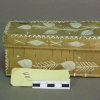
Small bark box with top and quill decoration of stem and leaf pattern with diamonds on side of top